Alternatives
An Audacity alternative you control by describing the edit
edytlab is a free, MIT-licensed desktop editor in which an AI agent runs local audio tools from a sentence you type; a hosted AI provider bills you for tokens unless you use Ollama. Audacity is also free and open source, and is the better fit if you record, use audio plugins or edit waveforms by hand.
Quick facts
| Fact | edytlab | Audacity |
|---|---|---|
| Price | The app is free. A hosted provider bills you for tokens; Ollama is free and runs on your machine. | Free: “Audacity has always been and will always remain free for everyone.” audacityteam.org · checked |
| License | MIT. | Yes, GPL v3: its Audacity 4 page lists the license as “Free, GPL v3”. audacityteam.org/audacity-4 · checked |
| Platforms | macOS (universal), Windows and Linux. | Windows (x86_64 and ARM64 installers), macOS (universal: Apple Silicon and Intel) and Linux (x86_64 and ARM64 AppImages). Current version 4.0.1. audacityteam.org/download · checked |
| Where the audio is processed | On your computer. Only the chat goes to the AI provider you pick, and with Ollama it stays on your machine too. The app sends no telemetry. | A desktop app: its privacy notice covers “our desktop app, Audacity”. The notice lists three network features, each of which it says can be disabled in preferences: update checking (on by default), error reporting and a random identifier that is stored only if you opt in. Audio is not among the data it lists. audacityteam.org/legal/privacy-notice · checked |
| AI features | An agent that calls edytlab's editing tools from your request. Transcription and stem separation run on your computer, after a one-time model download for each. | Optional Intel OpenVINO plugins for music separation (stems), noise suppression, music generation and continuation, and Whisper transcription. Its plugin page says these features “run 100% locally on your PC” with “no internet connection necessary”. A separate NVIDIA Broadcast denoiser works only on Windows with an NVIDIA RTX GPU. |
| Audio plugins | None: edytlab has no plugin hosting. | Its home page lists plugin support: “a vast selection of third-party plugins, including VST3, Nyquist and more”. audacityteam.org · checked |
Where Audacity is better
- Audio plugins. Besides the table row, Audacity's Audacity 4 page says LV2 plugins load “right alongside VST3 and Audio Units”. edytlab has no plugin hosting.
- Local AI plugins today. Audacity's plugin page lists a “Music Separation” plugin among its local ones; edytlab separates stems too, with HT-Demucs on your computer. A June 2025 post says the plugins reached macOS with Audacity 3.7.4, as a beta of sorts. We could not find a statement on Audacity's site that they work with Audacity 4, the current version, so check before you rely on them there.
- AI in Audacity's plugin store. Audacity's home page also promotes MuseHub plugins, one described as “Clean up spoken voice and create instant transcripts” and another as “Automatically split mixed-speaker audio into separate tracks”.
- Recording and hand editing. Audacity's FAQ lists recording live with a microphone or mixer and a spectrogram view among its features, and its blog marked the project's 25th anniversary in May 2025. edytlab is a new project.
- No AI provider needed. Audacity works without an AI provider or a key. edytlab's chat needs one: a hosted provider with your own key, or Ollama running on your machine.
Where edytlab differs
- Describe a multi-step job in words. Ask for something like “match this track to 124 BPM, crossfade it into the next, bring both to −14 LUFS and export a WAV”, and the agent calls the tools in order. You can hear the result at each step and undo it.
- A branching history, not one undo stack. Every state is a node in a graph. You can fork it, name it, compare two versions and revert, and undo follows the path you took.
- Loudness targets by name.
normalize_loudnesstakes a preset (Spotify and YouTube −14 LUFS, Apple Podcasts −16, broadcast −23) and sets a track's gain to reach it, capped at a peak ceiling (−1 dBFS by default). - Recipes you can replay over a folder.
export_recipewrites a session's steps to a JSON file with no audio in it, andbatch_applyruns that file on every audio file in a folder, each file becoming its own project.
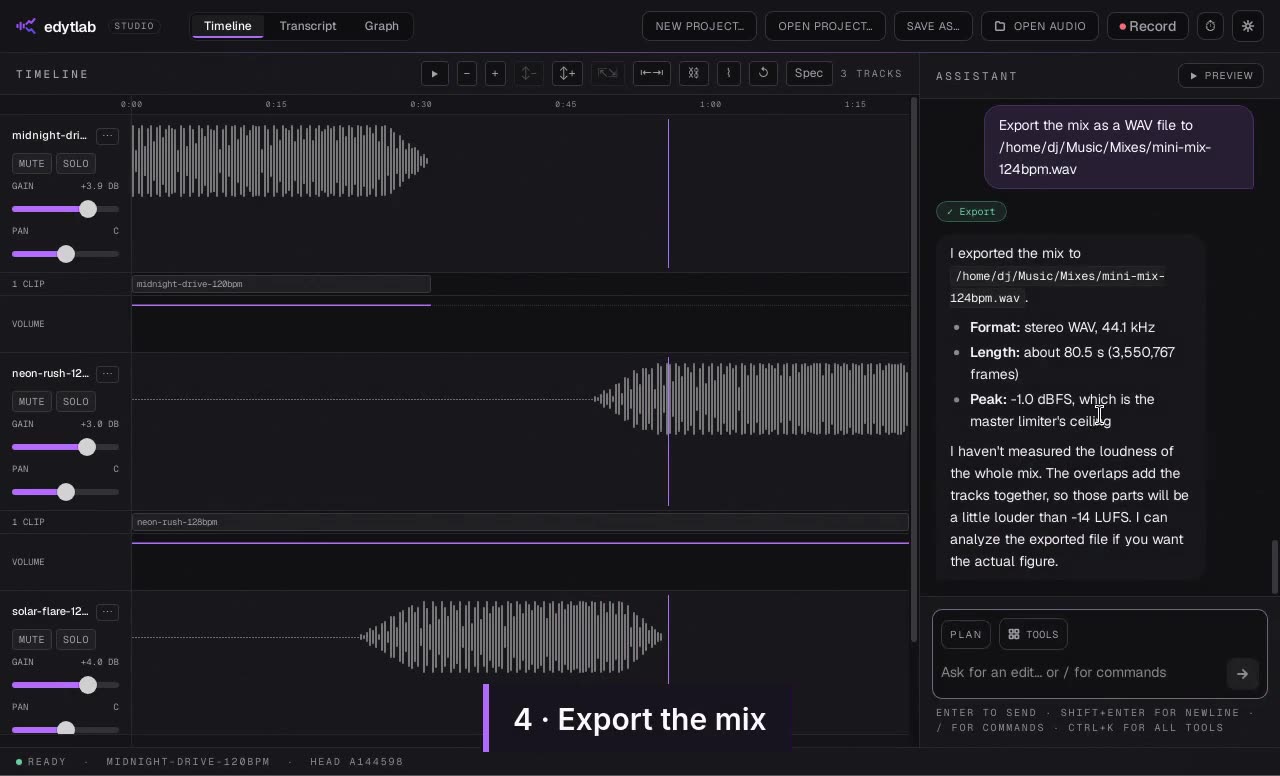 Length 1:42
A three-track mini-mix
Match three tracks to one tempo, join them with overlapping crossfades and export the mix.
Recorded in the real app with Claude, on short synthetic demo tracks. Waits sped up.
Use both: exports and labels
edytlab loads WAV, MP3, FLAC and other common audio formats and exports WAV, AIFF, FLAC, MP3 or OGG, so audio moves between the two as ordinary files. It has no importer for Audacity's own project files, so export the audio from Audacity first and load that.
Labels are the one place the two share a format. Audacity's manual says label tracks export to and import from tab-delimited plain text: start time in seconds, end time, then the label's text. edytlab's import_labels and export_labels read and write that layout. export_labels returns the text in the chat and writes no file, so save it as a .txt file to import into Audacity (File, Import, Labels); paste Audacity's exported text to the agent to go the other way.
Chat control inside Audacity
Third-party projects connect MCP-capable AI assistants to Audacity. One of them, AudacityMCP, says in its README that it works with Audacity 3.x and cannot control Audacity 4, and it points to a separate early-alpha project for Audacity 4 that needs a companion fork built from source. We have not tried either project.
Privacy
Audacity's privacy notice for Audacity 4 and newer, last updated 31 August 2026, is summarised in the table above. This page says nothing about Audacity's privacy beyond that notice.
edytlab's side is in the table too, and the local-first page lists what stays, what leaves, and what to expect from local models. The app has no update check. This website records visits with anonymous Vercel analytics; the privacy page says what.
An Audacity alternative for Linux, macOS and Windows, and what each costs
Both run on all three. edytlab is an Audacity alternative for Linux, an Audacity alternative on macOS and an Audacity alternative for Windows, and a free Audacity alternative that is also an open-source Audacity alternative, under the MIT license. Audacity itself is GPL v3, per its Audacity 4 page.
Audacity is free, though its FAQ notes that extra Audacity Cloud storage is something people pay for, and its Audacity 4 page says MuseHub lists free and paid plugins. edytlab's app is free too; a hosted provider bills you for tokens, at the rates on that provider's own price list.
Verdict
Choose Audacity if
- you record audio, or edit waveforms by hand and want that to be the main way you work;
- you rely on VST3, LV2, Audio Unit or Nyquist plugins;
- you want Audacity's local AI plugins today, and have checked that they support the version you run;
- you want no AI provider or key involved at all.
Choose edytlab if
- you would rather describe a multi-step job in a sentence than do each step by hand;
- you want a branching history, recipes you can replay over a folder, or loudness targets by name;
- you are happy to bring an AI provider's key, or run Ollama on your machine;
- you can work without audio plugins, and you are fine with stems that are estimates.
Why macOS and Windows warn when you open edytlab
The installers are not signed. The source is public, and the getting started guide has the steps.
Sources
- Audacity home page (audacityteam.org), checked
- Audacity 4 page (audacityteam.org/audacity-4), checked
- Audacity download page (audacityteam.org/download), checked
- Audacity privacy notice (Audacity 4 and newer) (audacityteam.org/legal/privacy-notice), checked
- Audacity AI plugins page (plugins.audacityteam.org/ai-plugins/ai-plugins), checked
- Audacity blog: OpenVINO AI plugins for macOS (audacityteam.org/blog/openvino-mac), checked
- Audacity FAQ (audacityteam.org/faq), checked
- Audacity blog: Audacity turns 25 years old (audacityteam.org/blog/25-years), checked
- Audacity manual: Importing and Exporting Labels (manual.audacityteam.org/man/importing_and_exporting_labels.html), checked
- AudacityMCP README (a third-party project) (github.com/xDarkzx/Audacity-MCP), checked